Showing posts with label Opera vs Reality. Show all posts

Thursday, 29 December 2016

Anne Boleyn and Anna Bolena, history and opera

 Wikipedia (english):
Anne Boleyn (/ˈbʊlɪn/, /bəˈlɪn/ or /bʊˈlɪn/)[3][4][5] (c. 1501[1] – 19 May 1536) was Queen of England from 1533 to 1536 as the second wife of King Henry VIII, and Marquess of Pembroke in her own right.[6] Henry's marriage to Anne, and her subsequent execution by beheading, made her a key figure in the political and religious upheaval that was the start of the English Reformation.

Henry VIII (28 June 1491 – 28 January 1547) was King of England from 21 April 1509 until his death. Henry was the second Tudor monarch, succeeding his father, Henry VII.
Henry is best known for his six marriages and, in particular, his efforts to have his first marriage, to Catherine of Aragon, annulled. His disagreement with the Pope on the question of such an annulment led Henry to initiate the English Reformation, separating the Church of England from papal authority and appointing himself the Supreme Head of the Church of England. Despite his resulting excommunication, Henry remained a believer in core Catholic theological teaching.

Henry Percy, 6th Earl of Northumberland, KG (c. 1502 – 1537) was an English nobleman, active as a military officer in the north.[1] He is now primarily remembered as the betrothed of Anne Boleyn, whom he was forced to give up before she became involved with King Henry VIII.

Jane Seymour (c. 1508 – 24 October 1537) was Queen of England from 1536 to 1537 as the third wife of King Henry VIII. She succeeded Anne Boleyn as queen consort following the latter's execution in May 1536. She died of postnatal complications less than two weeks after the birth of her only child, a son who became King Edward VI. She was the only one of Henry's wives to receive a queen's funeral, and his only consort to be buried beside him in St. George's Chapel, Windsor Castle.

George Boleyn, 2nd Viscount Rochford (c.1503 [1] /c. April 1504 [2] – 17 May 1536) was an English courtier and nobleman, and the brother of queen consort Anne Boleyn. This made him the brother-in-law of King Henry VIII and the maternal uncle of Queen Elizabeth I of England. A prominent figure in the politics of the early 1530s, he was convicted of incest with Anne during the period of her trial for high treason. They were both executed as a result.

Mark Smeaton (c. 1512 – 17 May 1536) was a musician at the court of Henry VIII of England, in the household of Queen Anne Boleyn. Smeaton, the Queen's brother George Boleyn (Viscount Rochford), Henry Norris, Francis Weston and William Brereton were executed for alleged treason and adultery with Queen Anne.

OPERA
Anna Bolena is an opera by Gaetano Donizetti. It is a tragedy. The 5 main characters all have flaws.

Anna Bolena (Anne Boleyn) wanted a crown so she chose Henry the 8th (Enrico), the King of England not Percy. Sir Riccardo Percy (in reality it was Henry Percy who was betrothed to Anne, but the opera could not have with the name Henry, Enrico in Italian). The real Anne Boleyn might possibly be a much better person than she is usually portrayed even in the history books. (19 May 1536)

Giovanna Seymour (Jane Seymour) fell in love with a king who already is married. She also was a close friend of the Queen, Anna Bolena herself. Giovanna wants to be free from the king's love since he is not free to marry Giovanna. She loves the King and the Queen.. She is flawed but the most virtous of the 5. The real Jane Seymour was also probably a more complex person, or may not. (24 October 1537)

Smeton (Mark Smeaton) is a young musician in the court. In the opera Smeton is more of a teen ager than a 23-24 year old person and beloved by Anna Bolena in an innocent way but he is in love with her. In love and a social climber, perhaps. In love in the opera, social climber in real life. But both showed he was just unlucky and a pawn in Henry's game. (17 May 1536)

Sir Riccardo Percy (Henry Percy) is mortally in love with Anna Bolena. He is a foolish, young man who plays right into Enrico's deadly plan to get free to marry Giovanna Seymour. The real Henry Percy was once bethrothed to Anne Boleyn but the bethrothal was without permisson of either the king or father. Anne Boleyn was not noble enough for young Henry Percy decided his father. (29 June 1537)
In May 1536 Northumberland, by now a man in broken health, formed one of the jury for the trial of Anne Boleyn. Anne is said to have confessed a precontract with him in the hope of saving her life.[1] He collapsed following the verdict and had to be carried out.[11]
Lord Rochefort (George Boleyn, 2nd Viscount Rochford) was Anna's brother and friend of Percy. He led Percy into his sister's room, it was supposed to be empty but Smeton was already there. And so Enrico had his evidence of adultery as he wanted. How Rochford thought the king's castle could be safe and how to stop the King to enter the Queen's room...

Enrico VIII (Henry VIII of England) is the king and he decides. Enrico has fallen out of love in Anna Bolena and is now in love with Giovanna Seymour. He wants to be loved as the man Enrico and yet he uses his role as king to get his way. He now hates Bolena and thinks she only wanted a crown and in that way he thinks he is not that guilty of all the deadly schemes he makes. Seymour is now his love and conviently he thinks FAMA, means that Seymour wants to be queen, but for Seymour the word means her virtue. Giovanna tries to save the life of the Queen, but Anna must accept to no longer be queen. Anna refuses and the King wins. Naturally he would have won anyway because he is The King.

The day after Anne's execution in 1536 the 45-year-old Henry became engaged to Seymour, who had been one of the Queen's ladies-in-waiting. They were married ten days later.[103] On 12 October 1537, Jane gave birth to a son, Prince Edward, the future Edward VI.[104]
Percy married another woman, and died not by the King's hand.

For reviews from my travels, see www.operaduetstravel.com

Wednesday, 15 February 2012

Elektra by Richard Strauss

4 x Elektra 2007-10-19, 2007-11-24, 2008-02-26, 2010-01-29. I have seen this opera 4 times but the lovely Rosenkavalier only twice. 

Elektra is a depressing opera about a depressing subject and it ends bad for everyone. For some people that love Richard Strauss the music is pure genious. But for me it is depressing and even though it is only one act it is LOOOOONG. And there are no beautiful arias or duets or anything. I know, given some years, I might disagree with what I just wrote but for now, it is the TRUTH. My truth, anyway. And I only watched it because of Agnes Baltsa as Klytemnestra, and I still don't love it. It takes too long before Klytemnestra arrives and then the fun is soon over. IT IS A GREEK TRAGEDY... no fun :-(

More information: Elektra (the opera), Richard Strauss, Electra (Greek mythology), Clytemnestra

BORING

For reviews from my travels, see www.operaduetstravel.com
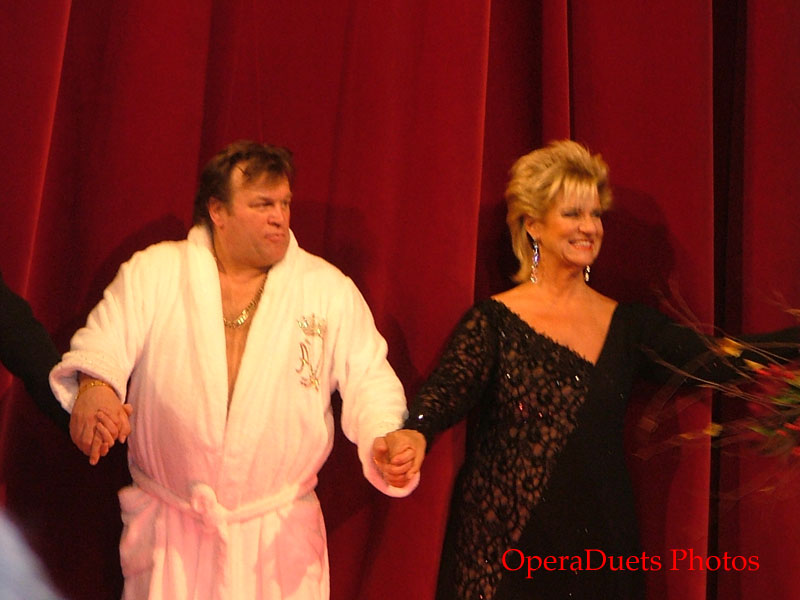
Die Lustige Witve by Franz Lehar

DEN GLADE ENKE  WENCHE FOSS OG KNUT WIGERT I "DEN GLADE ENKE" 1956. FOTO: STURLASON 


I have seen this operetta 3x :Die Lustige Witwe 1984-01-282000-06-212007-04-18.

I am obviously to young to have seen it when Norwegian Diva Wenche Foss was Hanna Glawari in Nationaltheatret in 1956, a decade before I was even born. On the photos Knut Wigert as Count Danilo. And it was with this photo I learnt about Opera and Operetta and The Merry Widow (Die Lustige Witwe in German, Den Glade Enke in Norwegian).

OK. Operetta is harder than Opera, but it is also lighter. The difficulties is that you are expected to talk and sing, and to do both well. Operetta is usually comedic so the singer is not just expected to do dialogues well but also to get the timing right. Shifting between singing operetta arias and duets etc that can be as difficult as most opera arias, duets etc and then to talk naturally in a theatre that is hard. And then it is language. All in the original German, or translated. Operetta can be wonderful when done right.

Hanna Glawari is the Merry Widow, a very rich widow. She is so rich that her money could save the economy of Pontevedro (Montenegro). Then there is Count Danilo Danilowitch, her former lover, who "works" in the Embassy of Montenegro (Pontevedro in the operetta). He wants her but he does not want to marry for money. But the embassy is decided he must woo her. All ends well.

Vilja Song and Maxim song is the most famous from this operetta. And of course, Lippen schweigen.


More information: The Merry Widow, Maxim, Montenegro, Franz Lehar

For reviews from my travels, see www.operaduetstravel.com

Saturday, 11 February 2012

Der Rosenkavalier by Richard Strauss


What a beautiful opera it is, Der Rosenkavalier by Richard Strauss. The music is easy on the ear, almost Mozart-like.

Die Marchallin is double the age of her lover, Count Octavian Rofrano.  But we are not supposed to be upset. That Octavian is just 17, his lover is higher up in nobility and older (ca. 35). But we are not supposed to be upset after all this happened in the past. It was another time and place, Vienna in the 1740s. Besides Octavian already has a history of many "conquests". In act 1, in the love scene of Marchallin and Octavian, if you listen carefully you hear a woman calling her lover a boy and almost baby him. Octavian, the young boy, a teenager as we would call him, imagins himself important but it is really she who rules him which is not necessary evil but they are certainly not equals. But we are not supposed to see something wrong in a young, not adult, boy/man and an older women, we are supposed to see the boy as super-lucky. We forget the power imbalance, and we should not forget it. Boys suffer when we think they are already sexualized when they have not even started their internal sexual journey, yet. Naturally it is only opera, so there you have it.

Die Marchallin is noble, Octavian is noble, Sophie is noble and the opera has one of the best endings. Baron Ochs is a bull in a China shop.

Read more, Wikipedia articles: Der Rosenkavalier, Richard Strauss, Empress Maria Theresa, Vienna, nobility.

I have seen this opera 2x: Der Rosenkavalier 1982-05-22, 1990-01-25
For reviews from my travels, see www.operaduetstravel.com

Tuesday, 7 February 2012

La Boheme by Puccini

My first attempt to make another love opera. It did not work. So I gave up. But how can you not like this opera. It seemed to obvious. It is a cute opera with some of the best music by Puccini. But no, it was boring and that it was a traditional production was not what my friend wanted. Alban Berg's Lulu in a hyper-modern production could have converted my friends to opera. I have been seen Lulu myself, but I saw Schönberg's Jakobsleiter and then I was really BORED.


Che gelida manina sung by Jose Carreras, can one wish for more? Evidently one can.

7x La Bohème 1989-01-23, 1990-12-29, 2007-06-30, 2007-09-01, 2010-03-20, 2010-03-28, 2011-04-23

So what have I learnt from my 7 La Bohemes? Naturally one does have a soprano to love as Mimi, and a tenor to care for as Rodolfo. But that is not enough, without a great supporting cast it will not really move you. A great supporting cast without an affective Mimi or Rodolfo will not work. LA BOHEME is really a straight forward type of history. It is no need to embellish it, just put it on and let there be realism. 

There are many kinds of realism. Sometimes less is more. Just remove what is not  necessary and as the story is real. La Boheme needs person-regie. No opera is fail-proof not even La Boheme. 

More info (wikipedia links): Giacomo Puccini, La Boheme, bohemianism,
Latin Quarter, Paris

For reviews from my travels, see www.operaduetstravel.com

Turandot: In questa reggia


All you need to understand Turandot is in the aria "In questa reggia".

Turandot is the daughter as the emperor. She has power and self-worth as the Daughter of the Sun (the emperor). As a child she was told the horrific story of the kidnapping and rape of her ancestress Lou-ling. Is her fear of men and fear of losing her power just unrealistic thinking? No. China is good for men, especially rich men who can afford to have several wives and multiple concubines. Choises for women is not many, not even for the daughter of an emperor.

For comic relief in this opera we have Ping, Pong and Pang. They complain that they have been reduced to helpers of the executioner. They dream of many things, from the innocent dreams of retiring to the residences in other parts of China to finally putting Turandot, the difficult woman who insists on being important just like a man, under the thumb of a man. Nowhere is the idea that if Turandot had a power in herself that no man could take from her there would have been no need for Turandot's neurotic angst.

Instead of caring for Turandot we care for Calaf who has no care for others except his own wishes. Calaf is just shallow. Where is his love for others, his father, Liu or even Turandot? Turandot has a reason for her cruel ideas, where is Calafs?

Liu is a woman/girl willing to sacrifice herself for love. In the opera Liu is what is expected of women, Turandot is portrayed as how every thing goes to hell if a woman is in charge.  And then there is the last duet of Turandot and Calaf (Principessa di Morte), and the cute forced kiss/rape that makes Turandot hot with love for her Prince. Wow!!

More info (wikipedia links): Giacomo Puccini, Turandot, China, Peking, mandarin, concubinage, misogyny, Emperor of China

8xTurandot 2003-06-28, 2005-08-30, 2006-04-30, 2009-01-17, 2009-07-30, 2009-07-31, 2010-05-13, 2012-01-21
For reviews from my travels, see www.operaduetstravel.com

Sunday, 15 January 2012

LA TRAVIATA by Verdi (only 5 times)

5x La Traviata 1984-06-20, 1993-01-15, 2002-12-14, 2003-07-31, 2006-03-22

Why have I only seen La Traviata 5 times? Mostly coincidence, and it is not my favorite opera by Verdi even if it is almost every one else favorite opera.

La traviata is an opera in three acts by Giuseppe Verdi set to an Italian libretto by Francesco Maria Piave. It is based on La dame aux Camélias (1852), a play adapted from the novel by Alexandre Dumas, fils. The title La traviata means literally The Fallen Woman, or perhaps more figuratively, The Woman Who Goes Astray. It was originally entitled Violetta, after the main character. (wikipedia)


Alexandre Dumas, fils was the original Alfredo Germont (opera) / Armand Duval (play), Père Germont/Duval was Alexandre Dumas père and Marie Duplessis was Marguerite Gautier (play)/Violetta Valery (opera). Naturally the author made himself heroic and naive. 

The double standard for men and women. A woman is ruined for life, a man is not.

For reviews from my travels, see www.operaduetstravel.com

Puccini's 5th opera TOSCA


14 x Tosca 1989-04-06, 1998-10-24, 2001-09-08, 2003-03-17, 2006-07-15, 2007-01-13, 2007-06-09, 2007-11-23, 2009-04-25, 2009-06-20, 2010-09-11, 2010-12-19, 2010-12-28, 2010-12-30

I have seen Tosca 14 times in 23 years. What does that mean? For me it means that this is one of the operas I have seen the most and in general it means that Tosca is one of the most popular operas. Tosca is the safe bet but one needs a great soprano as Tosca, a wonderful tenor as Cavaradossi and a menacing baritone/bass as Scarpia.

TOSCA, Giacomo Puccini, History - Italy - Rome, Napoleon, Battle of Marengo (14 June 1800), Melas, the Roman RepublicHistory of Italy (1559–1814),


For reviews from my travels, see www.operaduetstravel.com

Friday, 13 January 2012

Easter Parsifal in January


My first and only Parsifal was 10 years ago. So it is time to see it live sometime somewhere. And it was Placido Domingo as Parsifal on January 12, 2002 in Wiener Staatsoper. Naturally I have the CD with Placido and Jessye Norman. But I want a CD of the radio broadcast of Teatro Real's Parsifal from March 2001 with Placido and Agnes Baltsa. I was in Madrid in March 2001, could not record the radio broadcast because I was trying to get tickets for the performance and I am still angry with Teatro Real for making it so hard and then we tried the people outside the theatre and still, being first meant nothing.

Parsifal is an opera in three acts by Richard Wagner. It is loosely based on Wolfram von Eschenbach's Parzival, the 13th century epic poem of the Arthurian knight Parzival (Percival) and his quest for the Holy Grail, and on Chrétien de Troyes' Perceval, the Story of the Grail. (wikipedia)

King Arthur, Holy Grail. Parsifal is a quasi-Christian story. Kundry was cursed for laughing at Jesus and the cross. Parsifal is innocence that become wise through compassion. Kundry is the cathalyst for the chance but Parsifal does not have compassion for Kundry, a woman, only for Amfortas, a man. Gurnemanz is the voice of wisdom and compassion even towards Kundry.

More links:
A website devoted to Parsifal, Monsalvat.


For reviews from my travels, see www.operaduetstravel.com

Thursday, 12 January 2012

10 years since my first Nabucco

8 x Nabucco 2002-01-12, 2005-07-01, 2007-06-29, 2007-08-11, 2008-02-22, 2008-07-14, 2008-07-17, 2010-01-30

Opera by Giuseppe Verdi. Known as Verdi's 3rd opera and his first great success.   Nabucco, 9 March 1842. It has the most famous chorus by Giuseppe Verdi: Va, pensiero. The story is biblical and about the Babylonian King Nabucco.

It has the classical and iconic conversion scene of Nabucco. But I find the opera most interesting because of Abigaille, the supposedly eldest daughter of Nabucco. Unfortunately she is not so loved by her "father" as the "minor" Fenena. Abigaille is as fierce as Nabucco but she is in reality "a daughter of slaves" and therefore nothing more than a slave herself. Even Abigaille's love interest loves Fenena and rejects Abigaille. Abigaille just want to be loved, most of all by her father, Nabucco.

Naturally the opera is the bible plus more love and confusion so that it can it juice music.

For reviews from my travels, see www.operaduetstravel.com

Sunday, 8 January 2012

O Fledermaus, O Fledermaus


5 x Die Fledermaus 1985-07-241989-01-071999-05-121999-05-142007-09-23


Wiener Operette, Johann Strauss II, Die Fledermaus, New Years Eve, Gala, Guests


New Years Eve Gala of Die Fledermaus (called The Bat, in English) with Guest stars as simultanious guests of Prince Orlofskys ball as it guests in the opera house. Wow!!

That can be fun. But what can make it boring. This is an operetta not an opera. It is meant to be like opening up a bubbly Champagne. It should sparkle all the way. Operetta is like superlight fun, but it sparkles best when there is some serious thruth down. Real people with problems but with a sparkling, witty dialogue and the sparkly operetta sound. With the right touch from the director and singers than can do the dialogue just right act 1 and 2 will go like a dream. Actually, even act 3 could be a ball. Unfortunately act 3 even if there is some great music and singing usually makes you want to go home.

Then there is the language. German in German speaking countries, yes, naturally. But elsewhere it is the question: Making it all in German (dialogue, singing), or singing in German, everything else in the native tongue, or all translated.

No wonder I loved it in 1999 in Theater an der Wien with Agnes Baltsa as Orlofsky and Isabel Rey as Adele, naturally it was all in German, and it had a very bubbly, sparkly quality.

But I do hate Frosch and his comedic monologue, don't you, too?

For reviews from my travels, see www.operaduetstravel.com

Sunday, 4 December 2011

Andrea Chenier by Umberto Giordano

I have seen Andrea Chenier 4 times: 1998-10-18, 2004-02-13, 2007-10-17, 2011-01-29.

4 different productions, 4 cities.

Andrea Chenier is a historical person who died during the times of the French Revolution or rather during the terror reign of Robespierre. The love story is fiction, Carlo Gerard is a person that could have existed. 

The opera cannot be so easily set in another because it is set so firmly on historical ground. The last Andrea Chenier that I saw in Berlin (2011) was good but making Carlo Gerard to only pretend to be wounded was bad and stupid. From Barcelon (2007) a I remember der whiteness of the scenography and costumes and the falling of the guilliotine after each act. Vienna had a beautiful production very true to history or so it seem, my only regret is that I did not have a better camera. From Zurich (1998) I do not remember much but certainly it was a straight-forward telling of the story and I loved Gabriele Lechner as Maddalena.


For reviews from my travels, see www.operaduetstravel.com

Monday, 23 August 2010

The real Andrea Chenier

Luigi Illica's libretto ANDREA CHENIER
Come un bel dì di maggio
che con bacio di vento
e carezza di raggio
si spegne in firmamento,
col bacio io d'una rima,
carezza di poesia,
salgo l'estrema cima
dell'esistenza mia.
La sfera che cammina
per ogni umana sorte
ecco già mi avvicina
all'ora della morte,
e forse pria che l'ultima
mia strofe sia finita,
m'annuncerà il carnefice
la fine della vita.
Sia! Strofe, ultima Dea!
ancor dona al tuo poeta
la sfolgorante idea,
la fiamma consueta;
io, a te, mentre
tu vivida a me sgorghi dal cuore,
darò per rima il gelido
spiro d'un uom che muore.

The aria is based on the poem of André Chénier
Come un dernier rayon, come un dernier zephyre
Animent la fin d'un beau jour
Au pied de l'echafaud j'essaye encor ma lyre.
Peut-etre est-ce bientot mon tour.
Peut-etre avant que l'heure en cercle promenee
ait pose sur l'email brillant,
dans les soixante pas ou sa route est bornee,
son pied sonore et vigilant;
Le sommeil du tombeau pressera ma paupiere


Who was André Chénier?
A French poet who was a revolutionary (a moderate one: a leader of les Feuillants) and he was executed during the French Revolution. Why? He was a moderate and he would write against not only the aristocrats but against the revolution leaders likes Robespierre and Marat and others. Hypocrisy and cruelty was something André Chénier fought against.

He was not only a revolutionary and a poet, he was one of France' best writers. He was a titan of poetry and knowledge. He had the disadvantage of coming from a not so wealthy family. His father was a too honest man to become very rich. His mother claimed Greek heritage. André's brothers was also engaged in the Revolution, except Constantin (b. 1757) who became a lawyer and worked for his father. Louis-Sauveur (b. 1761) had a career in the army. Marie-Joseph (1764-1811)  became a famous Jacobin. He was the official dramatist of the Revolution. He had a gift for making enemies where André had a gift for friendship. André-Marie Chénier was the 3rd son and was born on October 30th 1762 and he died on a scaffold on July 25th 1794.

The accusation against Chénier (the opera) and reality?

Nemico della Patria?!
È vecchia fiaba che beatamente
ancor la beve il popolo.
Nato a Costantinopoli? Straniero!
Studiò a Saint Cyr? Soldato!
Traditore! Di Dumouriez un complice!
E poeta? Sovvertitor di cuori e di costumi!

André and his brother Louis-Sauveur were both in Saint-Lazare prison at the same time. When André saw the accusation he saw it was a mix-up with him and his brother. To explain it would easily mean death for his brother and would probably not do him any good. To be a suspect and to have a suspect as brother would be worse. Louis-Sauveur had a soldier (general) with Dumourieuz. André was born in Costantinople and had been a soldier (a short while) and he was certainly a poet and had written against the excesses of revolution.


In opera we have usually a love story and Giordano gives us one with Maddalena de Coigny, the innocent Aristocrat daughter. The real de Coigny was Aimée de Coigny, duchessse de Fleury who was not so innocent. She was married into aristocracy and had many lovers. André knew her and of her and she was not his love interest. There was another lady who was his chaste love, one of his few chaste ones.

My source: André Chenier,  his life and work 1762-1974 by Francis Scarfe, Oxford University Press 1965.  Although the book is in English without good understanding of French it is not always easy to follow. It is written by scholar who is well versed in English and French poetry. The author quotes from letters and book in the original French. He does not use the space to outline in any detail what it means, so unless the reader understand French much goes amiss. Several poems of André Chenier is quoted in this book, naturally all in French.

CONTENTS
List of plates  ix
Abbreviations  xi
Introduction  xiii

Part I
THE LIFE, DOWN TO THE REVOLUTION
1. Beginnings 1
2. 'Gallus' 23
3. Passion and Revolt 46
4. The Chevalier in London (1787-90)

Part II
THE WORK, DOWN TO THE REVOLUTION
5. His Views on Poetry  92
6. The Elegies  126
7. The Didactic and Narrative Poems 146
8. The Bucoliques 162

Part III
POETRY AND ACTION, 1790-4
9. First Steps in Politics (1790-1)  218
10. Chénier and the Feuillants  240
11. The Anti-Jacobin  258
12. The Suspect 281
13. Saint-Lazare 313
14. Thermidor  346

Conclusion 365

Appendix A. Boissy d'Anglas on Chénier  368
Appendix B. Lines written in Hood's Tavern  370
Appendix C. The Feuillant Manifesto  373

Bibliography 375
INDEX 383


ANDRE CHENIER, HIS LIFE AND WORK: 1762-1794

BONUS: Did you know that Roucher in the opera was already in Saint-Lazare when André came and they where executed on the same day...

For more reviews from my travels, see www.operaduetstravel.com

Saturday, 17 July 2010

Don Juan, who is he and what about the women


I have just seen two videos of Don Giovanni. One was from Salzburg Festival 1987 with Herbert von Karajan as conductor and Samuel Ramey (Don Giovanni), Ferruccio Furlanetto (Leporello), Gösta Winbergh (Don Ottavio), Alexander Malta (Masetto), Donna Anna (Anna Tomowa-Sintow), Donna Elvira (Julia Varady) and Kathleen Battle (Zerlina). The other video was from Norwegian National Opera with Knut Skram (Don Giovanni), Svein Carlsen (Leporello), Kjell Magnus Sandve (Don Ottavio), Svein Arild Thorsen (Masetto), Hillevi Martinpelto (Donna Anna), Kjertsi Ekeberg (Donna Elvira), Ingjerd Oda Mantor (Zerlina), sung in Norwegian and from 1988.

And since the second video started with the director giving his view of the opera and I read a soprano's view about Donna Anna as lying all the time and therefore not being sympathetic enough for her. The Swedish director Göran Järvefelt's view about Donna Anna being hurt by Don Giovanni's escapades because she found her self to love Don Giovanni that I would earlier have accepted is not something I can believe in. Why could not Donna Anna find herself suddenly in love with Don Giovanni? If Donna Anna loves Don Giovanni and care not for Don Ottavio then the soprano is right: Donna Anna is simply lying all the time and is not sympathetic. But that view would mean that one would find a way make the beginning of the opera something much nicer than it really was.

Don Giovanni is inside Donna Anna's home, he came right into her bedchamber. Was he invited by Donna Anna? Legal entrance. No. Donna Anna believed the man in her private, safe room was her fiancé, Don Ottavio. But it was a stranger. Her room was no longer safe, and the man ... It was rape, or at least an attempt to rape. She fought against the assailant. Her father came to her rescue, but the stranger killed him. How is this to be construed as being just an sexual encounter.

What about the relation between Donna Anna and Don Ottavio? Donna Anna is accused of lying. But could a women be open and truthful to the men in her lives about being raped? At that time it was impossible. And now?... In that society a woman needs to know when and what to say if she is not to loose all respect.

If one does not romanticize the encounter with Don Giovanni then you see a woman struggling with the effects of rape that makes it so hard to show affections to her beloved Don Ottavio. In this view Donna Anna is sympathetic and should not be portrayed as hard and unloving woman.

No wonder we have an easier time with Donna Elvira who just simply still loved Don Giovanni no matter what. We don't need to think about what a society and what patriarchy can do towards women. We can just sigh, ah, it's love... But of course, Donna Elvira only that.

Instead of asking about Zerlina's point of view, we often overlook her to go straight to Massetto. That is not fair.

Why should modern audiences ask whether or it is fair that Don Giovanni goes to hell for denying all the rules o society? Why not care about those hurt by Don Giovanni's actions? Personally I care nothing about who the commandatore should be presenting in the last act? I care for those hurt by any sociopath going around destroying other people's lives

For more reviews from my travels, see www.operaduetstravel.com

Saturday, 1 May 2010

The real Guarani people, a fight for survival

For the Guarani, land is the origin of all life. But violent invasions by ranchers have devastated their territory and nearly all of their land has been stolen.
Guarani children starve and their leaders have been assassinated. Hundreds of Guarani men, women and children have committed suicide.


Act now to help the Guarani

Your support is vital for the Guarani’s survival. There are lots of ways you can help.


Video of fragments from the opera Guarany by Gomes

Synopsis of the opera

Finale


Carlos Gomes' Il Guarany: the Frontiers of Miscegenation in nineteenth-century grand opera

For more reviews from my travels, see www.operaduetstravel.com

Sunday, 23 August 2009

Lucrezia Borgia: "Don Alfonso, mio quarto marito"


In real life Lucrezia Borgia was only married 3 times with Alfonso, Duke of Ferrari being the 3rd and last. And he loved her.


For more reviews from my travels, see www.operaduetstravel.com

Tuesday, 24 March 2009

Opera vs Reality: Lucrezia Borgia

I love the opera LUCREZIA BORGIA by Gaetano Donizetti.What a woman she is, Lucrezia Borgia. But in the opera she is murderess, who mostly use poison as her weapon. But the truth, she is not a villain nor is she just an ordinary woman liviing in Renaissance Italy. She is, however, sister of Cesare Borgia who was used to use murder to get his will, and daughter of the one of the most infamous and corrupt Popes of time, Pope Alexander VI.

Who was Lucrezia Borgia? Not a fool, neither a complete innocent woman nor a villainess. Living in the court of Pope Alexander VI even as she was a favourite child of a Pope who really loved his children, it was a hard life and nothing was too hidden. Not a place for innocence but neither a hotbed for incest. The charges of incest between Lucrezia and her father and brother propably came because the Borgia family was never popular and that the idea of the Pope as a father only could have fatherly feelings towards Lucrezia was hard to fanthom. And that Cesare Borgia, the most harden man of Italy, the man portrayed in Macchiavelli's IL PRINCIPE,  should have only brotherly feelings towards Lucrezia was also hard to fanthom, because Cesare really was a cruel man and had many lives on his conscience.

Renaissance, a time of beauty in culture but a hard time to live in. Cruel, corrupt. Money was their god in many ways.

What is true in the opera? Well, Lucrezia Borgia was certainly married to Alfono d'Este, Duke of Ferrara. But in the opera she sings "Don Alfonso, mio quarto marito" as a menace, meaning that she in the opera probably killed of the 3 other husbands by poison and that it could easily be Alfonso's destiny as well. But in reality was Don Alfonso her 3rd husband not 4th. In the opera it is often played like Alfonso is suspicious towards Lucrezia and does not really love her. And it was often told by those who was likely to backtalk any Borgia, that Alfonso never loved Lucrezia. But the opposite was true, he who was totally against a marriage to a Borgia came to love her very much. Every time that Lucrezia was ill, and it was often, did Alfonso come as fast as he could to stay with her. Did she love him? Not initially, but in the end a love came from the respect to a man who had much that she could admire him for. A man who hated Cesare Borgia and all that he stood for could for his wife's wish even try to get Cesare out of some trouble. Only love could make the proud Don Alfonso do something like that.

Lucrezia was smart, she had worked to get this 3rd marriage a place that she could be safe from all the meddling for her father the Pope and from her brother, a man who probably killed Lucrezia's second husband that she had loved. She managed to be loved by almost all of the d'Este family. Only Isabella d'Este never liked har, the proud and noble woman hated the upstart Borgia. And it did not help that Lucrezia became lover to Isabella's husband. So. Lucrezia was no Saint. But her Christian belief was true, and she was not too proud to help the people of Ferrara. She was a good, kind and strong administrator. In war time active in helping the people and so on. She was also an entrepreneur and a great negotiator of deals with ordinary people. Unlike many other noble people she would always work for a deal that was not only good for her but good for the others, too. And if there was problems, she would negotiate over and over again until reason won. She was fair to people. And the people of Ferrara loved her. They also loved Don Alfonso who also was a great administrator and had stopped many corrupt dealings that was after his father Duke Ercole I of Ferrara.

Front Cover
Lucrezia Borgia: Life, Love and Death in Renaissance Italy
By Sarah Bradford
Edition: illustrated
Published by Penguin, 2005
ISBN 014101413X, 9780141014135
432 pages


For more reviews from my travels, see www.operaduetstravel.com

Monday, 26 January 2009

Lucrezia Borgia, opera by Donizettti

While searching for literature about the real Lucrezia Borgia, I found this:
Title:
Jury Trials and Gerrymanders: The Legal Effort to Maintain Segregation in July of 1957.
Authors:
Klinetobe, Charles1
Source:
Historian; Summer2006, Vol. 68 Issue 2, p221-240, 20p
 
Not really something about Lucrezia here, but interesting stuff none the less.

What I wanted was this one:
Lucrezia Borgia: Life, love and death in renaissance Italy.
Terpstra, N
HISTORIAN
68 (2): 377-378 SUM 2006
2006

Instead of reading yet another review of Sarah Bradford's book about Lucrezia Borgia, I'll read the book.
What I have read, and I recommend reading to others is an article:
Lucrezia Borgia as entrepreneur (Giovanni Gonzaga)
Ghirardo, Diane Yvonne
RENAISSANCE QUARTERLY
61 (1): 53-91 SPR 2008
2008


Very interesting ... Go to your library ...now

Indexing (document details)
People:Borgia, Lucrezia,  Hugo, Victor,  Ghirardo, Diane Yvonne
Author(s):Anonymous
Document types:Expanded Reporting
Publication title:Obesity, Fitness & Wellness Week. Atlanta: Jan 24, 2009.  pg. 3027
Source type:Periodical
ISSN:15316386
ProQuest document ID:1626426071
Text Word Count723
Document URL:http://proquest.umi.com/pqdweb?did=1626426071&sid=1&Fmt=3&clientId=58117&RQT=309&VName=PQD


For more reviews from my travels, see www.operaduetstravel.com

Thursday, 13 November 2008

Analyze That: LE CID by Jules Massenet

 
I saw LE CID in Opernhaus Zurich this year (2008-02-03
Only the tenor's aria: O souverain, O juge, O pere; and the soprano's, Chimene's aria: Pleurez mes yeux; is reallyy known.
Music aside, read in Wikipedia: LE CID (opera) 
Wikipedia says: Le Cid is a tragicomedy written by Pierre Corneille and published in 1636. It is based on the legend of El Cid.
On EL CID (also Wikipedia)
Rodrigo (or Ruy) Díaz de Vivar (c. 1040, Vivar, near Burgos – July 10, 1099, Valencia), known as El Cid Campeador, was a Castilian nobleman, a gifted military leader and diplomat who, after being exiled, conquered and governed the city of Valencia. Rodrigo Díaz II was educated in the royal court of Castile and became the alférez, or chief general, of Alfonso VI, and his most valuable asset in the fight against the Moors.
The nickname "El Cid" comes from the Spanish article "El", which means "The" and the dialectal Arab word سيد "sïdi" or sayyid, which means "Lord". So "El Cid" could be translated as "The Lord". The title "Campeador" is a vulgar Latin word that could be translated as "master of military arts". He is considered the national hero of Spain.
--- Maybe I will analyze LE CID myself, really, one time later and not just rip of from Wikipedia.---
Or maybe I have some readers that will do me the honor of commenting their analysis...
For more reviews from my travels, see www.operaduetstravel.com