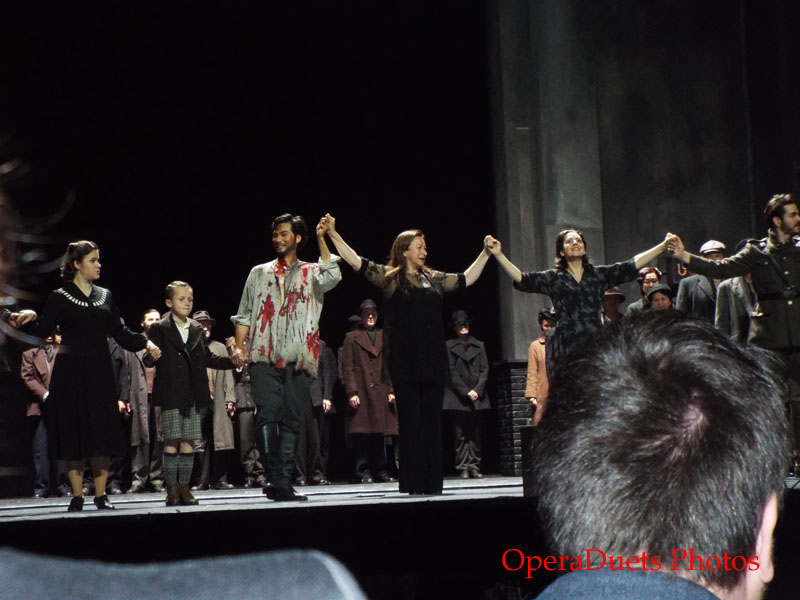
I have changed my mind. No longer is Don Carlo my favorite opera by Verdi: it is LA BATTAGLIA DI LEGNANO.
Simone Young conducted a wonderful cast. Don Carlo need 6 extraordinary singers, La Battaglia needs 3. But in Hamburg also the minor roles was great.
Yonghoon Lee was the Tenor and magnificent from beginning to end. Alexia Voulgaridou was the Soprano, Lida is a coloratura tour-de-force. And then Giorgio Coduro as the Baritone, as sweet or forceful whenever was needed.
Bravi tutti!
This was my irst impression from Hamburg's production of La Battaglia di Legnano.
Federico Barbarossa = Tigran Martirossian
Rolando = Giorgio Caoduro
Lida = Alexia Voulgaridou
Imelda = Rebecca Jo Loeb
Arrigo = Yonghoon Lee
Marcowaldo = Viktor Rud
1. Console di Milano = Vincenzo Neri
2. Console di Milano = Alin Anca
Il Podestá di Como = Szymon Kobylinski
Un scudiero di Arrigo = Manuel Günther
Un araldo = Sergiu Saplacan
Simone Young, conductor
Inszenierung - David Alden
Bühnenbild - Charles Edwards
Kostüme - Brigitte Reiffenstuel
Licht - Adam Silverman
Chor - Eberhard Friedrich
What a wonderful opera night in Hamburg!!!
The great Simone Young conducted a superb cast. Loved the music and singing. This is an opera that shoud be played more in theatres around the world.
First it starts with one of the most beautiful Verdi ouvertures. Simone Young knows how to get best of the orchestra with great clarity it shines. What a demanding, physical work it is to be a conductor. Not only that but concentration and a great precision is needed.
Viva Italia!!! That is the theme of the opera. An Exit sign is on the stage. What does that mean? USCITA means just EXIT, but why is it onstage. It does naturally help the people to find the exit door but it is just never explained.
The chorus is just not on the stage but on the roof/floor of the stage. "Viva Italia" is sung a capella with the chorus dressed in classic Milanese cloths. The men are on the second floor. The women on the stage. The men onstage are actors not singers unless they have a role like being the Herald and such. A wounded Arrigo comes onstage, he is weak and wounded in his arm, he need support of a stick to hold himself erect. Yonghoon Lee sings Arrigo's aria ernestly and with a haunty beauty. Then comes Rolando and the two friends are now reunited. The young Giorgio Caoduro is convincing as Rolando. In Hamburg Arrigo and Rolando is of the same age. Rolando is an important man in Milano, he is the captain of the city. Arrigo has just been released from war prison. La Battaglia is an opera filled with patriotic moments and it the most Milanese opera. All of the opera happens in Milano, the main city of Lombardy.
The marches of La Battagia gives the opera the most vigorous feeling.
After the scene of prisoners of war coming wounded to the city and not that welcomed by officials. Hospital bed and now out, in comes women happy for Italia. So strange that Lida is not happy. Married with one child, she cannot forget her first love, Arrigo. Her father and brothers are now all dead. Her father arranged the marriage of Lida and Rolando. She thinks Arrigo is dead, too. Alexia Voulgaridou is really a wonderful Lida. A wonderful coloratura. Unfortunately Marcowaldo, who has been allowed to stay at their home by a generous Rolando. He is the servant who fancies his boss' wife. This is a real annoyance for Lida but worse is it that he is present when Lida is beeing told Arrigo is alive. That a sad Lida is suddenly giddily happy is a giveaway. Great coloratura aria!!! Then Rolando comes with Arrigo. Now Marcowaldo has double reason to doubt. Then Rolando has to go out on official business. Arrigo is now alone with Lida. He wastes no time in accusing Lida of all sorts. The singing is glorious and musically the duet is just wonderful. But Lida never gets the chance to explain herself. Arrigo seems to believe that Lida as a woman could be free to chose whatever she wants. Arrigo is blind with fury. I loved you as a god, now I see you as a demon. But what would an opera be if the characters was thinking before acting. Opera is often all emotion. Reason be damned!
So now Lida is back to unhappiness again.
In Hamburg it seems that the opera is happening during the risorgimento. Act 2 starts with the Mayor of Milano and a group of important who is about to agree with the opressor Barbarossa. Rolando and then Arrigo are outraged of the patriotic weakness. They will never accept Barbarossi. But then suddenly Barbarossa with his big, red beard appears. He was in the room all the time while Rolando and Arrigo was insulting him. Great scene. Barbarossa has already surrounded the city. He gloats, Rolando and Arrigo counter that with patriotic will will Milano cast out the foreign army. The city is in turmoil and burns already. Barbarossa is not the destiny of Milano. NEVER!!
ACT 3
Arrigp desperate of love and patriot as he is. He joins the Cavalieri della Morte. Dressed in the flag of Italy with a skull in his hand Arrigo swears to be a Cavlier della Morte. The scene is of glorious gloom and a musical feast. And on this note, the lights go out and we can now eat, drink, relax.
Why a pause at the beginning of act 3? Musically it simply ends better so it feels right. After act 2 we just feel a scene is over but it not as clear. Anyway, that was the decision in Hamburg.
So after a pause of 25 minutes we are in the Rolando household. Lida is extremely agitated, Arrigo has joined the death/suicide squad. This is just a scene of extreme feeling. Lida is in secret writing a note to Arrigo. Imelda agrees to carry it, to give it to Arrigo. But sleazy Marcowaldo gets hold of the document. Rolando comes to Lida to say goodbye and since it is war again and he could die. He is very emotial and Lida becomes teary-eyed, too. Their boy is seated and Rolando gives instructs Lida "tell him he is of Italian blood, then him he is my son". Beautiful duet. Then a scene with Rolando and Arrigo alone. Rolando does not know that Arrigio has joined the death squad so he asks Arrigo to take care of his wife and son. Arrigo who has shown no mercy toward Lida, he can feel sorry Rolando, the man who "stole" Lida from him. Beatiful scene. As Rolando is about to depart Marcowaldo shows the letter Lida wrote to Arrigo and naturally Rolando waste no time to think and goes into fury about the "betrayal" immediately.
Arrigo is in his appartement feeling sorry for himself. So sure of his death is Arrigo so he is writing his mother to prepare her. Having heard no word from Arrigo since Arrigo has not received the note, Lida comes. She confesses her love. But even as that makes Arrigo happy Lida tells him he must live for his mother just as she must live for son. The appartment is on the second floor and the stage is covered in blue light as it night and the river runs there. Rolando appears, Arrigo hides Lida. Rolando has decided against killing Arrigo. Arrigo is to die the slow, agonizing death of shame. Rolando knows that for Arrigo that is worse than death. For Lida, another shame, to no longer be a part of the Rolando household, Rolando will no longer accept her as his wife. Infamia!!! Desperately Arrigo throws himself in the river. He will find a way to join the Componi della Morte. This scene is just Verdi magic.
Act 4. War is over. Lida is overjoyed to hear that Arrigo managed to get to his squad, His shame has been averted. Masses celebrate. A mourning sound is heard. The death squad leads a mortally wounded Arrigo, a man dying for the fatherland cannot lie. Rolando must understand that Lida is innocent. Will Rolando not accept and hold the hand of Arrigo. Rolando forgives Arrigo and possibly Lida, too. Arrigo dies as hero. The opera ends beautifully!!!!!