Saturday, 18 February 2012
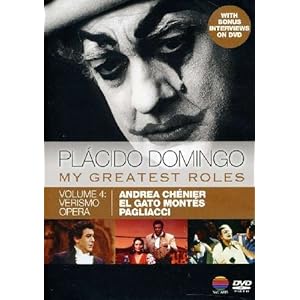
Placido's Greatest Roles: ANDREA CHENIER
Video snippet
ANDREA CHENIER by Umberto Giordano
Conductor Julius Rudel - 1985(LI)
Orchestra - Covent Garden
Chorus - Covent Garden
Andrea Chénier - Plácido Domingo
Carlo Gérard - Giorgio Zancanaro
Madeleine di Coigny - Anna Tomowa-Sintow
La mulatta Bersi - Cynthia Buchan
La Contessa di Coigny - Patricia Johnson
Madelon - Anny Schlemm
Roucher - Jonathan Summers
Il sanculotto Mathieu - Rodney Macann
Fouquier Tinville - John Gibbs
Un Incredible - John Dobson
Pietro Fléville - Gordon Sandison
L'abate - Alexander Oliver
Dumas - Roderick Earle
Schmidt - Eric Garrett
------------------------------------------------------------------
DVD (Video) - Warner Vision 5046 68357-2 (2004)ª
For reviews from my travels, see www.operaduetstravel.com
Wednesday, 15 February 2012
Elektra by Richard Strauss
For reviews from my travels, see www.operaduetstravel.com
Die Lustige Witve by Franz Lehar
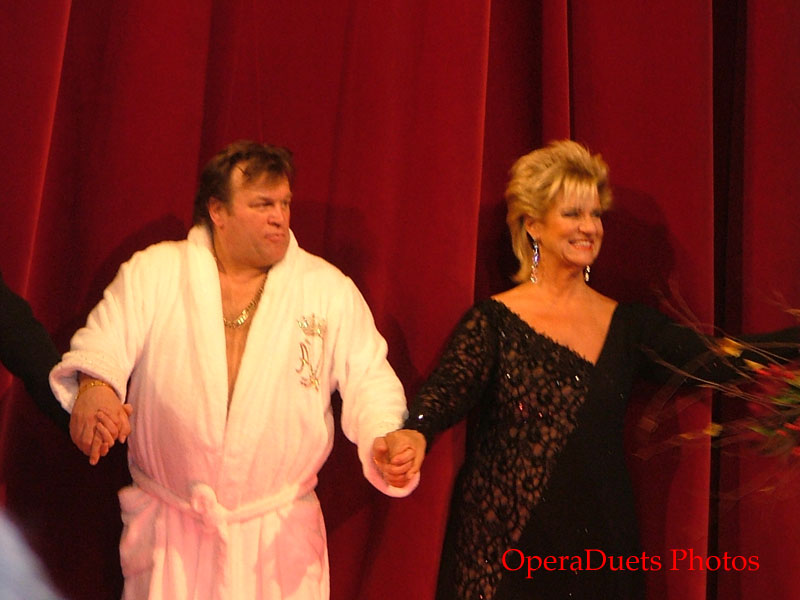
| DEN GLADE ENKE WENCHE FOSS OG KNUT WIGERT I "DEN GLADE ENKE" 1956. FOTO: STURLASON |
I have seen this operetta 3x :
I am obviously to young to have seen it when Norwegian Diva Wenche Foss was Hanna Glawari in Nationaltheatret in 1956, a decade before I was even born. On the photos Knut Wigert as Count Danilo. And it was with this photo I learnt about Opera and Operetta and The Merry Widow (Die Lustige Witwe in German, Den Glade Enke in Norwegian).
OK. Operetta is harder than Opera, but it is also lighter. The difficulties is that you are expected to talk and sing, and to do both well. Operetta is usually comedic so the singer is not just expected to do dialogues well but also to get the timing right. Shifting between singing operetta arias and duets etc that can be as difficult as most opera arias, duets etc and then to talk naturally in a theatre that is hard. And then it is language. All in the original German, or translated. Operetta can be wonderful when done right.
Hanna Glawari is the Merry Widow, a very rich widow. She is so rich that her money could save the economy of Pontevedro (Montenegro). Then there is Count Danilo Danilowitch, her former lover, who "works" in the Embassy of Montenegro (Pontevedro in the operetta). He wants her but he does not want to marry for money. But the embassy is decided he must woo her. All ends well.
Vilja Song and Maxim song is the most famous from this operetta. And of course, Lippen schweigen.
More information: The Merry Widow, Maxim, Montenegro, Franz Lehar
For reviews from my travels, see www.operaduetstravel.com
Saturday, 11 February 2012
Der Rosenkavalier by Richard Strauss
What a beautiful opera it is, Der Rosenkavalier by Richard Strauss. The music is easy on the ear, almost Mozart-like.
Die Marchallin is double the age of her lover, Count Octavian Rofrano. But we are not supposed to be upset. That Octavian is just 17, his lover is higher up in nobility and older (ca. 35). But we are not supposed to be upset after all this happened in the past. It was another time and place, Vienna in the 1740s. Besides Octavian already has a history of many "conquests". In act 1, in the love scene of Marchallin and Octavian, if you listen carefully you hear a woman calling her lover a boy and almost baby him. Octavian, the young boy, a teenager as we would call him, imagins himself important but it is really she who rules him which is not necessary evil but they are certainly not equals. But we are not supposed to see something wrong in a young, not adult, boy/man and an older women, we are supposed to see the boy as super-lucky. We forget the power imbalance, and we should not forget it. Boys suffer when we think they are already sexualized when they have not even started their internal sexual journey, yet. Naturally it is only opera, so there you have it.
Die Marchallin is noble, Octavian is noble, Sophie is noble and the opera has one of the best endings. Baron Ochs is a bull in a China shop.
Read more, Wikipedia articles: Der Rosenkavalier, Richard Strauss, Empress Maria Theresa, Vienna, nobility.
I have seen this opera 2
For reviews from my travels, see www.operaduetstravel.com
Tuesday, 7 February 2012
La Boheme by Puccini
Che gelida manina sung by Jose Carreras, can one wish for more? Evidently one can.
7x
Latin Quarter, Paris
For reviews from my travels, see www.operaduetstravel.com
Turandot: In questa reggia
All you need to understand Turandot is in the aria "In questa reggia".
Turandot is the daughter as the emperor. She has power and self-worth as the Daughter of the Sun (the emperor). As a child she was told the horrific story of the kidnapping and rape of her ancestress Lou-ling. Is her fear of men and fear of losing her power just unrealistic thinking? No. China is good for men, especially rich men who can afford to have several wives and multiple concubines. Choises for women is not many, not even for the daughter of an emperor.
For comic relief in this opera we have Ping, Pong and Pang. They complain that they have been reduced to helpers of the executioner. They dream of many things, from the innocent dreams of retiring to the residences in other parts of China to finally putting Turandot, the difficult woman who insists on being important just like a man, under the thumb of a man. Nowhere is the idea that if Turandot had a power in herself that no man could take from her there would have been no need for Turandot's neurotic angst.
Instead of caring for Turandot we care for Calaf who has no care for others except his own wishes. Calaf is just shallow. Where is his love for others, his father, Liu or even Turandot? Turandot has a reason for her cruel ideas, where is Calafs?
Liu is a woman/girl willing to sacrifice herself for love. In the opera Liu is what is expected of women, Turandot is portrayed as how every thing goes to hell if a woman is in charge. And then there is the last duet of Turandot and Calaf (Principessa di Morte), and the cute forced kiss/rape that makes Turandot hot with love for her Prince. Wow!!
More info (wikipedia links): Giacomo Puccini, Turandot, China, Peking, mandarin, concubinage, misogyny, Emperor of China
8
For reviews from my travels, see www.operaduetstravel.com
Sunday, 22 January 2012
Turandot, January 21th 2012
I had come to Zurich to see Jose Cura as Calaf. But he got a serious head cold so he couldn't sing. Johan Botha was to sing instead. It was like Lohengrin singing Calaf, I thought. But his large girth did not prevent him much to be an effective Calaf. He has a big and beautiful, clear voice. He stood and delivered the goods, but his acting consisted mainly of smiling. Those smiles seemed to me to come sometimes at inapprobiate times, but maybe it was another way of telling that Calaf is more of a cad than a romantic hero.
Martina Serafin was Turandot. She was very different from Paoletta Marrocu as Turandot in this production. Unfortunately she had some difficulties in the aria "In questa reggia" where the demands of the role seemed to somewhat beyond her so Botha's voice could easily overwhelm her in the "enigmi sono tre, la morte una". Martina Serafin was an otherwise great Turandot who I am sure will be able to takle all the demands of Turandot in a few years.
I also came to Zurich to see Isabel Rey as Liu. She was great. From a somewhat weak Signore, ascolta in the first act to the most wonderful and greatest rendition of Tu che in gel sei cinta. Wow, that was amazing!!!
Pavel Daniluk was simply an amazing Timur. His voice was grand and demanding.
What can one say abou the production? Partly it is super traditional, and partly modern. The action does happen in China, in legendary times. BUT the unknown prince (Calaf), Timur and Liu is dressed modernly. AND Calaf uses a computer to answer the riddles. The audience laughed when Johan Botha took the computer. In April 2006 (last time I saw this production) they did not laugh when Cura took the computer. But naturally it was silly then and now. But I guess then it was not so strange to see the chorus dressed in modern cloths when Turandot tells that she know the name of the stranger: His name is Love. Then we are in modern Shanghai and Turandot disrobes her traditional dress to the modern one, and Calaf and Turandot can enjoy a champagne, romantic meal served by modern times Ping, Pang and Pong.