Sunday, 4 March 2012

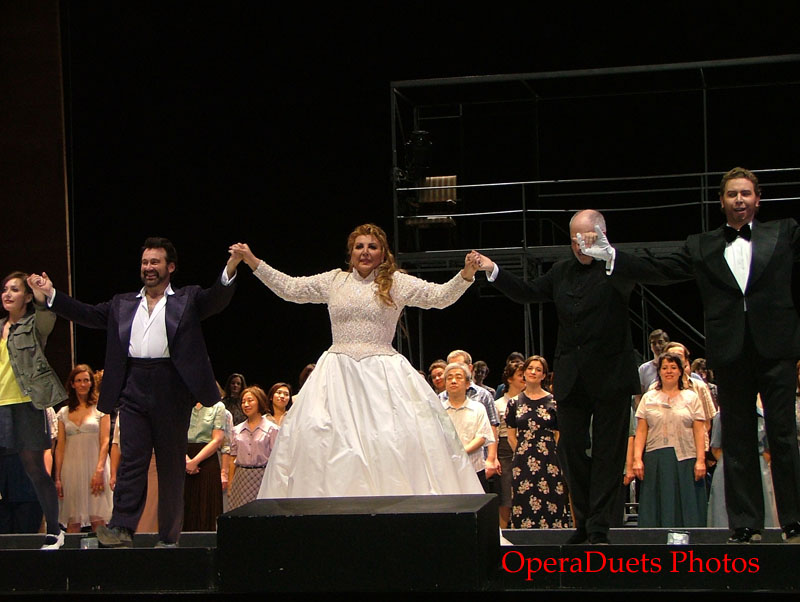
A great operatic night of Turandot (2012-03-03)

2012-03-03 Turandot (Puccini), Deutsche Oper Berlin

Turandot = Maria Guleghina
Liu = Manuela Uhl
Calaf = Roy Cornelius Smith
Timur = Stephen Bronk
Ping = Alexey Bogdanchikov
Pang = Jörg Schörner
Pong = Yosep Kang
Althoum = Peter Maus
Mandarin = Hyung-Wook Lee
1st voice = Kathryn Lewek
2nd voice = Rachel Hauge

Jesus Lopez Cobos, conductor

Director - Lorenzo Fioroni
Stage-design - Paul Zoller
Costume-design - Katharina Gault
Choir Conductor - William Spaulding
Giacomo Puccini

TURANDOT

Online-Karten: € 28,- | 48,- | 69,- | 86,-
[zuzüglich € 2,- Service-Gebühr]

Samstag, 03.03.2012, 19:30 Uhr
Dauer: ca. 2 Stunden 30 Minuten | Eine Pause
Dramma lirico in drei Akten
Libretto von Giuseppe Adami und Renato Simoni, nach dem Schauspiel von Carlo Gozzi
Uraufführung am 25. April 1926 in Mailand
Premiere an der Deutschen Oper Berlin am 13. September 2008


BRAVA, Manuela Uhl!

BRAVO, Roy Cornelius Smith!

BRAVA, Maria Guleghina!!!!!!


I saw this production in 2010 with Maria Guleghina and Jose Cura as Turandot and Calaf. The Regie was the same, offensive nonsense. In 2010 I said not even Maria Guleghina could save it. But she was the saving grace now. She sang the most wonderful IN QUESTA REGGIA and her duets with Roy Cornelius Smith (Calaf) was also pure magic. Manuela Uhl was a fantastic Liu vocally but the this was not the best production to showcase her talent. She did well as she acted like the director wanted her too, but that meant she was not able to really be Liu at the same time.

Remembering this Turandot from 2010 made it possible for me just to take in what was right about this Turandot and ignore the nonsense. The singers was in their best form. The chorus sang well. Jesus Lopez Cobos is a wonderful conductor.

It was an amazing operatic evening. Roy Cornelius Smith was just great as Calaf. Maria Guleghina simply was a great Turandot. Biggest surprise for me was Manuela Uhl in her great scene, it was simply unbelievable singing. BRAVA!!!!

For reviews from my travels, see www.operaduetstravel.com

Saturday, 3 March 2012

Aida in black and white

Aida is an Ethiopian slave in Egypt. But she is the daughter of Amonasro, the King of Ethiopia, so she is also the Ethiopian princess.

It is so easy, too easy to decide that a slave must have black skin. When we are thinking of slavery we are too often just thinking about the Black slaves in the US, mostly we choose to think only of the slavery in Southern USA. It is important to know about it and we should know more and care deeper about the hideousness of slavery and understand that although slavery was in the end becoming illegal because the racism that were underneath it was never truly tackled a slavery by another name was allowed. How could the Slave that became the Help be free to choose an occupation, to be able to talk back to Whites without fear, to be paid a livable salary when laws made people of the "wrong" color less and with a protection that was not there.

Slave and slave-owner. It is an black and white issue. Slavery is always wrong. But it is old. Much older than USA, older than the modern Europe, too. It was not always about the color of your skin. But is was always a way to get rich and powerful. Slave trade was and is lucrative. Yes, it is not over yet.

To accept slavery is to accept that we can all loose our worth as humans. It is to say that kidnappings should be legal, and that the kidnapper should be able to do what ever he/she wants without anyone stopping it. However kind the slave-owner is or however humanely the slave-owner treats the slave, slavery of any kind should not and must not be accepted anytime anywhere.

Aida, the Ethiopian princess, was kidnapped by some Egyptian soldiers. They thought of it as a normal part of being a soldier: you win the battles, you take men, women and children to be slaves in your home country. But it was not just an Egyptian thing, or African thing to do this. These kind of kidnappings where people became slavery could happen everywhere. Although it was then thought as natural or normal to do this we should never think that made it RIGHT.

Anyway Black/White. Is there any real need to paint the Ethiopians black, so African, while making the Egyptians so white, so European? Aida is not Otello, Radames is not Desdemona. In Verdi's Otello he is called the Moor, and it is refered to his blackness and Desdemona is pure and golden, racism is a part of the whole story. In Aida we have Celeste Aida, forma divina (heavenly Aida, divine body) so she can be of any color. The conflict in Aida is not so much that she is a slave and he is the leader of Egyptian army. No, it is she is Ethiopian and he is Egyptian, she loves her country but Radames, the enemy.

Why don't we see that Ethiopia and Egypt are like Norway and Sweden, brother countries almost as alike as twins, yet rivals. From the time that White Men went to Egypt to steel artifacts, archeology, get rich, and from the time Whites saw the pyramides Egyptians have been seen as honorary Europeans. Ethiopia they also that Pharaohs and pyramides, in fact Egypt was part of Ethiopia. But that is history that is ignored.


- Posted using BlogPress from my iPad

Saturday, 18 February 2012

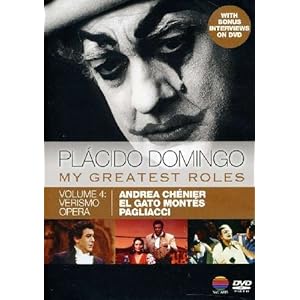
Placido's Greatest Roles: ANDREA CHENIER

Placido Domingo : My Greatest Roles - Vol.4 Verismo Opera [DVD] [2011]
Video snippet
ANDREA CHENIER by Umberto Giordano

Conductor Julius Rudel - 1985(LI)
Orchestra - Covent Garden
Chorus - Covent Garden


Andrea Chénier - Plácido Domingo
Carlo Gérard - Giorgio Zancanaro
Madeleine di Coigny - Anna Tomowa-Sintow
La mulatta Bersi - Cynthia Buchan
La Contessa di Coigny - Patricia Johnson
Madelon - Anny Schlemm
Roucher - Jonathan Summers
Il sanculotto Mathieu - Rodney Macann
Fouquier Tinville - John Gibbs
Un Incredible - John Dobson
Pietro Fléville - Gordon Sandison
L'abate - Alexander Oliver
Dumas - Roderick Earle
Schmidt - Eric Garrett
------------------------------------------------------------------
DVD (Video) - Warner Vision 5046 68357-2 (2004)ª


For reviews from my travels, see www.operaduetstravel.com
Wednesday, 15 February 2012

Elektra by Richard Strauss

4 x Elektra 2007-10-19, 2007-11-24, 2008-02-26, 2010-01-29. I have seen this opera 4 times but the lovely Rosenkavalier only twice. 

Elektra is a depressing opera about a depressing subject and it ends bad for everyone. For some people that love Richard Strauss the music is pure genious. But for me it is depressing and even though it is only one act it is LOOOOONG. And there are no beautiful arias or duets or anything. I know, given some years, I might disagree with what I just wrote but for now, it is the TRUTH. My truth, anyway. And I only watched it because of Agnes Baltsa as Klytemnestra, and I still don't love it. It takes too long before Klytemnestra arrives and then the fun is soon over. IT IS A GREEK TRAGEDY... no fun :-(

More information: Elektra (the opera), Richard Strauss, Electra (Greek mythology), Clytemnestra

BORING

For reviews from my travels, see www.operaduetstravel.com
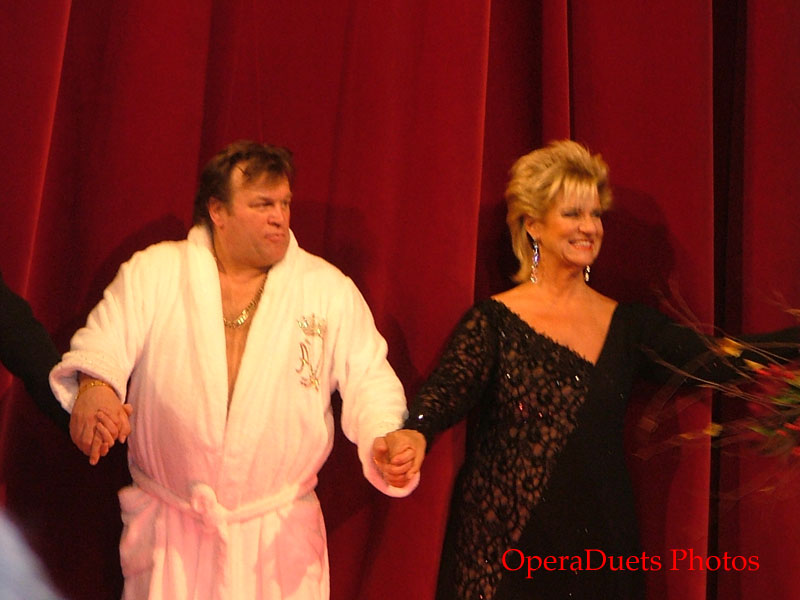
Die Lustige Witve by Franz Lehar

DEN GLADE ENKE  WENCHE FOSS OG KNUT WIGERT I "DEN GLADE ENKE" 1956. FOTO: STURLASON 


I have seen this operetta 3x :Die Lustige Witwe 1984-01-282000-06-212007-04-18.

I am obviously to young to have seen it when Norwegian Diva Wenche Foss was Hanna Glawari in Nationaltheatret in 1956, a decade before I was even born. On the photos Knut Wigert as Count Danilo. And it was with this photo I learnt about Opera and Operetta and The Merry Widow (Die Lustige Witwe in German, Den Glade Enke in Norwegian).

OK. Operetta is harder than Opera, but it is also lighter. The difficulties is that you are expected to talk and sing, and to do both well. Operetta is usually comedic so the singer is not just expected to do dialogues well but also to get the timing right. Shifting between singing operetta arias and duets etc that can be as difficult as most opera arias, duets etc and then to talk naturally in a theatre that is hard. And then it is language. All in the original German, or translated. Operetta can be wonderful when done right.

Hanna Glawari is the Merry Widow, a very rich widow. She is so rich that her money could save the economy of Pontevedro (Montenegro). Then there is Count Danilo Danilowitch, her former lover, who "works" in the Embassy of Montenegro (Pontevedro in the operetta). He wants her but he does not want to marry for money. But the embassy is decided he must woo her. All ends well.

Vilja Song and Maxim song is the most famous from this operetta. And of course, Lippen schweigen.


More information: The Merry Widow, Maxim, Montenegro, Franz Lehar

For reviews from my travels, see www.operaduetstravel.com

Saturday, 11 February 2012

Der Rosenkavalier by Richard Strauss


What a beautiful opera it is, Der Rosenkavalier by Richard Strauss. The music is easy on the ear, almost Mozart-like.

Die Marchallin is double the age of her lover, Count Octavian Rofrano.  But we are not supposed to be upset. That Octavian is just 17, his lover is higher up in nobility and older (ca. 35). But we are not supposed to be upset after all this happened in the past. It was another time and place, Vienna in the 1740s. Besides Octavian already has a history of many "conquests". In act 1, in the love scene of Marchallin and Octavian, if you listen carefully you hear a woman calling her lover a boy and almost baby him. Octavian, the young boy, a teenager as we would call him, imagins himself important but it is really she who rules him which is not necessary evil but they are certainly not equals. But we are not supposed to see something wrong in a young, not adult, boy/man and an older women, we are supposed to see the boy as super-lucky. We forget the power imbalance, and we should not forget it. Boys suffer when we think they are already sexualized when they have not even started their internal sexual journey, yet. Naturally it is only opera, so there you have it.

Die Marchallin is noble, Octavian is noble, Sophie is noble and the opera has one of the best endings. Baron Ochs is a bull in a China shop.

Read more, Wikipedia articles: Der Rosenkavalier, Richard Strauss, Empress Maria Theresa, Vienna, nobility.

I have seen this opera 2x: Der Rosenkavalier 1982-05-22, 1990-01-25
For reviews from my travels, see www.operaduetstravel.com

Tuesday, 7 February 2012

La Boheme by Puccini

My first attempt to make another love opera. It did not work. So I gave up. But how can you not like this opera. It seemed to obvious. It is a cute opera with some of the best music by Puccini. But no, it was boring and that it was a traditional production was not what my friend wanted. Alban Berg's Lulu in a hyper-modern production could have converted my friends to opera. I have been seen Lulu myself, but I saw Schönberg's Jakobsleiter and then I was really BORED.


Che gelida manina sung by Jose Carreras, can one wish for more? Evidently one can.

7x La Bohème 1989-01-23, 1990-12-29, 2007-06-30, 2007-09-01, 2010-03-20, 2010-03-28, 2011-04-23

So what have I learnt from my 7 La Bohemes? Naturally one does have a soprano to love as Mimi, and a tenor to care for as Rodolfo. But that is not enough, without a great supporting cast it will not really move you. A great supporting cast without an affective Mimi or Rodolfo will not work. LA BOHEME is really a straight forward type of history. It is no need to embellish it, just put it on and let there be realism. 

There are many kinds of realism. Sometimes less is more. Just remove what is not  necessary and as the story is real. La Boheme needs person-regie. No opera is fail-proof not even La Boheme. 

More info (wikipedia links): Giacomo Puccini, La Boheme, bohemianism,
Latin Quarter, Paris

For reviews from my travels, see www.operaduetstravel.com