Sunday, 6 January 2008

Monday, 24 December 2007
Wednesday, 5 December 2007
Dec 5: Happy Birthday to Josep Carreras & Jose Cura
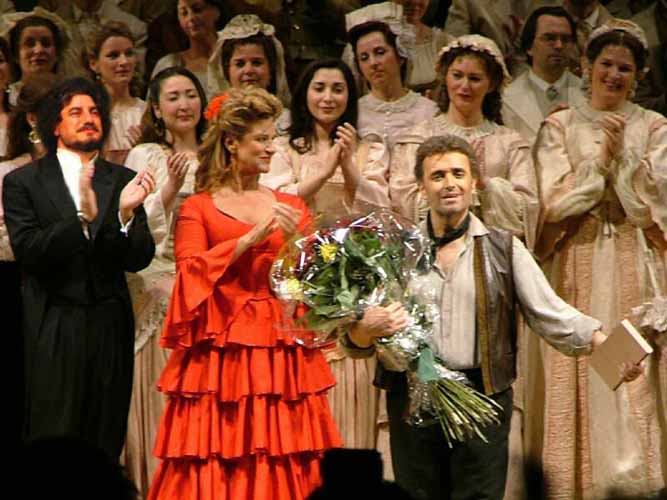 Photo is from the Jose Carreras Gala in Vienna 2004, February 27: I have replaced the original conductor David Gimenez with Jose Cura, Agnes Baltsa was Carmen, and Josep Carreras was Don Jose.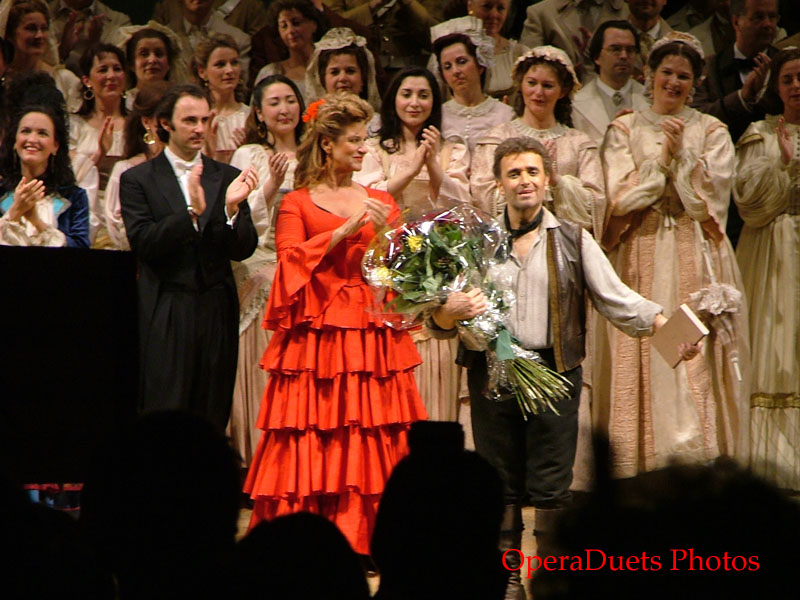
Happy Birthday to both tenors!!!
Josep Carreras (b. Barcelona, Spain 1946 December 5th), www.josepcarreras.com:
JOSE CARRERAS occupies a privileged position in the music world. Born in Barcelona, he studied music in his hometown. In 1970 he started his professional career in the Gran Teatre del Liceu of Barcelona in NABUCCO and LUCREZIA BORGIA.
His meteoric musical career resulted in early debuts at the world's most prestigious opera theatres and festivals, including the Theatre alla Scala of Milan ; the New York Metropolitan Opera House; San Francisco Opera; the Vienna Staatsoper; London's Royal Opera House; the Oper of Munich; Chicago's Lyric Opera; and the Festivals of Salzburg; Aix en Provence; Edimburgh and Verona.
José Carreras has collaborated with the most renowned orchestra conductors including Herbert von Karajan (an artistic and personal relationship which lasted over twelve years and included performances
in Salzburg, Berlin and Vienna), Claudio Abbado, Riccardo Muti, Lorin Maazel, Riccardo Chailly, Colin Davis, Giuseppe Sinopoli, James Levine, Carlo Maria Giulini, Leonard Bernstein and Zubin Metha, and with pre-eminent stage directors such as: Franco Zeffirelli, Jean Pierre Ponnelle, Giorgio Strehler, Luigi Comencini and Harold Prince.
His repertoire includes over sixty operas and has performed for Television, Cinema and Video several operatic films. His extensive discography includes over 150 recordings, notably 50 complete operas, oratories, popular and classical recitals. He has been awarded with many Gold and Platinum Discs world-wide.
He has given frequent recitals in the world's most famous halls: Carnegie Hall and the Avery Fisher Hall in New York; the Royal Festival Hall, the Barbican Hall and the Royal Albert Hall in London; the Salle Pleyel in Paris, at the Musikverein and Konzerthaus of Vienna, the Berlin Philarmonie, Suntory Hall and NHK Hall in Tokyo, the Grosses Festspielhaus of Salzburg, the Philarmonie and the Hercules Saal in Munich, the Palau de la Música of Barcelona, the Teatro Real of Madrid, the Accademia Santa Cecilia of Rome.
Among the numerous national and international prizes and distinctions which have been bestowed upon José Carreras, there are an Emmy from the Academy of Television, Arts and Sciences of the United States; the Grand Prix du Disque from the Academy of Paris; the Luigi Illica Prize; a 1991 Grammy Award; the Sir Lawrence Olivier Award for his performance in "Stiffelio" at the Royal Opera House, Covent Garden; Kammersänger and Lifetime Honorary Member of the Vienna Staatsoper; Honorary Member of the London Royal Academy of Music; he received the Gold Medal of the New York Spanish Institute; the Gold Medal of the City of Vienna ; the Gold Medal of Fine Arts bestowed by His Majesty the King of Spain; the Gold Medal of the City of Barcelona; the Gold Medal of the Generalitat of Catalunya; Prince of Asturias Award 1991; Commandeur de l'Ordre des Arts et des Lettres and Chevalier dans l'Ordre de la Légion d'Honneur de la République Française; Gran Croce di Cavaliere and Grande Ufficiale della Repubblica Italiana; Honour Medal of the Bavarian Government, Grand Honour Award of the Austrian Republic, Komandor's Cross of the Order of Merit of the Polish Republic, Commandeur de la Médaille du Sahametrei of the Royal Cambodian Government, Goodwill Ambassador of UNESCO and The Albert Schweitzer Music Award 1996. Furthermore he is Honorary President of the Julian Gayarre International Singing Competition and Honorary President of the London Arts Orchestra.
He has also been awarded the title Doctor Honoris Causa by the University of Barcelona (Spain), the Universities of Loughborough and Sheffield (United Kingdom), the University Mendeleyev of Moscow (Russia), the University of Camerino (Italy), the Napier University in Edinburgh (Scotland), the Rutgers University (United States), the Miguel Hernández University of Elche (Spain) and, most recently, the University of Coimbra (Portugal). He is Honorary Member of the European Society for Medicine, of the Leukaemia Support Group and the European Haematology Association. He is also Honorary Patron of the European Society for Medical Oncology. He has been awarded the Gold Medal of the Catalan Transplant Society, the Diamond Tulip Award of the Stichting Day by Day Foundation of the Netherlands, the St. Boniface General Hospital Research Foundation 1996 International Award and in February 2004 the Golden Cross of the Social Solidarity bestowed by Her Majesty the Queen of Spain.
José Cura, www.josecura.com:
Chapter 1
For music lovers, it is a rare treat to come across an original: an artist whose talent, vision, and integrity set him apart from the rest; a singer whose distinctive voice is instantly and indelibly lodged in one's memory; an actor whose presence on stage breathes fresh life into tired characters; a conductor who, like the singer and the actor, cannot conceive music without a full dramatic meaning; a man whose passion and commitment are rivaled only by his intelligence and sense of humanity. Such an artist is José Cura.
Born in Rosario, Santa Fe, Argentina, on 5 December 1962, José Cura's musical talent matured quickly: at 12 he was playing guitar under Juan di Lorenzo's guidance; at 15 he debuted as a choral director; and at 16 he began studies in composition with Carlos Castro and piano with Zulma Cabrera. In 1982, he entered the School of the Arts at the National University of Rosario to continue his musical education; the following year he became assistant conductor for the university choir. At 21, he won a grant to study at the Teatro Colón in Buenos Aires where he remained for six months. Cura continued to sing in the opera chorus while focusing on composition and conducting until 1988, when he began working with Horacio Amauri to develop proper singing technique.
Determined to make a career in opera, José Cura moved to Italy in 1991 and began voice training with Vittorio Terranova. In February 1992 he made his debut in Verona as the father in Henze's “Pollicino.” In Genoa he played Le Remendado in Bizet's “Carmen” and the Capitano de ballestrieri in Verdi's “Simon Boccanegra.” Cura was engaged in March 1993 for his first major role, starring as Jan in the Trieste production of Bibalo's “Signorina Giuglia.”
Signorina Giulia, Trieste: 'Jan, the servant, perfidious and cynical, was the young Argentine tenor José Cura, extraordinary as a singer-actor.' Trieste Oggi, April 1993
In the same year, he made his debut in the Straus operetta, “Ein waltzertraum,” and attracted critical attention for his performance as Albert Gregor in Janacek's “The Makropoulos Case.”
Cura began 1994 with a series of highly successful debuts: Ismaele in Verdi's “Nabucco” in Genoa and Don Alvaro in Verdi's “La Forza del Destino” in Turin were followed with Ruggero in the world premiere of the third version of Puccini's “La Rondine” (Turin) and Roberto in the same composer's rarely performed first opera, “Le Villi” (Martina Franca); the latter performance is particularly noteworthy for providing Cura's first complete opera recording.
Le Villi, Martina Franca: 'The Argentine tenor José Cura, a truly great performer with a vocal instrument beyond the common, very strong and expressive, imposed himself in the role of the main character, showing that he is an authentic spinto-drammatico tenor, a register today quite rare. Cura, besides a big and beautiful voice, has the stage power of a true actor.' Il Quotidiano, August 1994
La Rondine, Turin: 'The future looks bright for the Argentine tenor José Cura, who has a lyrical voice with brilliant top notes. The role showed off his considerable stage presence.' Opera, 1994
In November, he made his US debut in Chicago as Loris Ipanov in Giordano's “Fedora,” opposite Mirella Freni; he subsequently reprised the role in Trieste in 1995, in London in 1996, in Vienna in 1997 and 1998, and in Tokyo, Zurich and Lecce, Italy, in 1998.
Fedora, Chicago: 'May God bless the mother that gave you birth.' Exito, December 1994
Cura capped the year with a gala concert at the Teatro Colón, marking his solo debut in Argentina's most important musical venue.
He continued adding roles to his expanding repertoire in 1995. In February, he returned to Italy to star as Paolo il Bello in the Palermo production of Zandonai's “Francesca da Rimini.” In June Cura debuted in London's Royal Opera House (ROH), Covent Garden, in the title role of “Stiffelio” on the opening night of the Verdi Festival.
Stiffelio, London: 'What made last night particularly thrilling was the Opera House debut performance of Argentinean tenor, José Cura, in the title role... His Stiffelio sucks the audience into a personality festering with piety, priggishness, hypocrisy, and irrepressible rage.' Evening Standard, June 1995
Stiffelio, London: 'The Argentine tenor is tall and imposing of stature, and the top of his voice is thrillingly free and secure…He has a nice line in flashing eyes and flaring nostrils, and neatly suggested the man's fundamentalist smugness in the early scenes. Above all there is an elemental power to his stage persona which is well suited to the role.' The Times, Jun 1995
Stiffelio, London: '... Cura is a real find, an Otello in waiting.' Independent, June1995
In July he sang his first Cavaradossi (“Tosca”) at the Puccini Festival in Torre del Lago. That September he made his first appearance on stage in Paris in the Opéra Bastille's production of “Nabucco” and in November, he starred in his first “Fedora” in Europe at Covent Garden.
Nabucco, Paris: '... the fascination arrives with the Argentinean José Cura, a Latin-burning Ismaele. This brilliant tenor, easy and natural, has a golden career ahead of him.' Tribune de Genève, September 1995
Fedora, London: '[Cura] is a superb actor, a convincing-looking hero and an intelligent, spontaneous and gifted musician…I have no doubt that Cura, with his unusually distinctive sound and equally abundant talent, will also rise to the dreaded super-tenor status as special hero by appointment to the cognoscenti.' Evening Standard, Nov 1995
In 1996, Cura built upon his burgeoning reputation and solidified his position as one of the most promising tenors of his generation. Following his portrayal of Osaka in Mascagni's allegorical opera “Iris” at the Rome Opera in January (available on CD), he returned to London to star in Saint-Saëns' “Samson et Dalila,” a role for which he has received universal acclaim. For his debuts in Los Angeles and San Francisco, Cura added two roles to his repertoire, Pollione in Bellini's “Norma” and Don José in “Carmen.”
Samson et Dalila, London: 'The young Argentinean never seems to put a foot wrong. His Samson is full of soul; a commanding and vibrant tenor performance that captures the Hebrew leader's weaknesses with as much theatrical devotion as his god-like strengths....' Evening Standard, January 1996
Samson et Dalila, London: 'There's superbly musical singing from the Samson of José Cura...it's a handsome, firm, incisive sound, and Cura makes a powerful presence of the stage. The audience was ecstatic.' Independent on Sunday, February 1996
Norma, Los Angeles: '...and yet it is because of a tenor that fans will be clamoring for tickets for Norma, if not for other reason than to say that they saw José Cura then. The young Argentine, making his local debut Thursday, has being singing professionally for only a few years. But Cura has it all. He has that special presence that causes you to never stop noticing him when he is on stage. He is exceptionally good-looking and could easily suit popular television or film. He sings with a firmness of voice that is smooth across the registers yet commandingly virile. His pitches are dead-on. He gives each phrase a natural musical shape, he can act, and it surely doesn't hurt that he happens to be a conductor and composer. Best of all, Cura proved an ensemble player of the most noble sort, doing nothing to upstage the performance only enhance it.' Los Angeles Times, September 1996
Norma, Los Angeles: '... it was José Cura, as Pollione, with his breezy strutting, his chiseled gold coin looks, and his silvery incandescent voice, who announced the arrival of a huge new talent.' Downtown News, September 1996
Carmen, San Francisco: 'Blessed with dashing good looks and a dancer's presence, the young Argentine tenor made a riveting impression. If his technique is a little reckless, the thrill of the voice is undeniable.' San Francisco Chronicle, October 1996
After performances in Verdi's “Il Corsaro” in Turin and Puccini's “Tosca” in London, Cura traveled to Melbourne and Sydney to take part in the Puccini Spectacular, a show specifically developed for his Australian debut.
Tosca, London: 'The young Argentinean super-tenor-to-be has already made two immensely impressive Covent Garden role debuts this season, first as Ipanov in the gripping revival of Fedora and more recently as Samson in Saint-Saëns' opera. Cura's performances are always profoundly moving, expertly paced, and vividly acted, his Cavaradossi is no exception.' Evening Standard, April 1996
Puccini Spectacular, Sydney and Melbourne: 'By popular acclaim the night belonged to José Cura, the audience roaring its approval of the personable young tenor at the curtain calls. He is highly impressive in straight-from-the-shoulder passages. The powerful timbre and vigorous delivery in such sections tends to outshine his equally effective interpretations of ''E lucevan le stelle'' and ardent, non-hysterical ''Nessun dorma''.' The Age, May 1996.
Other key roles included Le Villi, Leoncavallo's “Pagliacci” and Giordano's “Andrea Chénier” at Opernhaus Zurich, Mascagni's “Cavalleria Rusticana” at the Ravenna Festival (conducted by Riccardo Muti and broadcast on Italian television), and “Pagliacci” at Amsterdam's Concertgebouw (conducted by Riccardo Chailly and televised live). In December, he starred in the Puccini segment of the BBC “Great Composers” documentary, telecast in December 1997.
Tuesday, 4 December 2007
Terje Stensvold Wiener Staatsoper Debut

Staatsoperndebüt
Wotan in
DIE WALKÜRE
6. Dezember 2007
Terje Stensvold
Der Norweger Terje Stensvold war vorerst an der Norwegischen Staatsoper fest angestellt, wo er zahlreiche Hauptrollen sang, u. a. Mephisto, Jago, Don Giovanni, Danilo, Figaro, Klingsor und Gianni Schicchi. Im Jahre 2000 begann seine internationale Karriere, die ihn u. a. an Häuser wie die Opéra La Monnaie in Brüssel, nach Monte Carlo, an das Royal Opera House Covent Garden, an die Hamburgische Staatsoper, die Oper Frankfurt, nach Stuttgart, Düsseldorf, Edinburgh, Barcelona, an die Deutsche Oper Berlin, Deutsche Staatsoper Berlin und Komische Oper Berlin führte. Zu seinen wichtigsten Partien zählen Scarpia (Tosca), Holländer (Der fliegende Holländer), Pizarro (Fidelio), Jochanaan (Salome), Barak (Die Frau ohne Schatten), Balstrode (Peter Grimes) und Dr. Schön (Lulu). Derzeitigen Pläne umfassen u. a. Wotan/Wanderer in der Neuinszenierung von Wagners Ring des Nibelungen an der Königlichen Oper Stockholm, an der Deutschen Oper Berlin und in Frankfurt, Pizarro in Covent Garden London, Berlin und Barcelona, Barak in Amsterdam und Philip II. (Don Calos) mit der Canadian Opera Company Toronto. Terje Stensvold ist auch als Konzertsänger sehr gefragt. An der Wiener Staatsoper debütiert er in der Saison 2007/08 als Wotan in der WALKÜRE am 6. Dezember und ist hier im Frühjahr außerdem als Holländer (April) und als Jochanaan (Mai) zu hören. Letztere Partie hat er schon im April 2007 im Rahmen des Gastspiels der Wiener Staatsoper in Zaragoza gesungen.
Wiener Staatsoper website
Monday, 26 November 2007
Hotels in Vienna and Budapest
I almost always book my hotels via hrs.de. It is multi-lingual and you can get hotel room to special HRS price and you get many details about the hotels.
But sometimes you choose wrong hotel. I never found Hotel Schönbrunnerstrasse, Vienna. Probably went in the wrong direction, I was armed only with a Google map. But I remembered last time in Vienna when I stayed in hotel 900 meters from the opera, I saw a hotel closer to Karlplatz and Staatsoper, Papageno. So I went to Westbahnhof and the internet cafe and book a room in Hotel Papageno. Better for me, no need to take U-bahn to Staatsoper, I could just walk, and closer than my earlier hotel. Not mention easier when I was going to Budapest by train, just a few stations with U-Bahn to Westbahnhof.
My hotel in Budapest was K+K Opera, a great hotel only few meters from the opera house and I mean few (20 meters max). And it just wonderful, great hotel, nice people, wonderful rooms and bath-tub. Wellness centre and free internet in the rooms. I never tried the wellness centre and I did not have my laptop with me so I never tried it in the internet in my room. But I did get to use one of the 3 pc's in the lobby. Breakfast was good and varied. Another lovely room. So next time in Budapest I will try to get a room in this hotel, K+K Opera.
My taxi from the Budapest train station, Budapest Keleti, to my hotel costed 4000 HUF. Did I pay too much. I also took a taxi from the hotel to the airport, that costed 6000 HUF. My hotel arranged that and I needed to pay by credit card, I had only 5000 HUF left, so they asked that the taxi had possibility for customers to pay by credit card.
My plane from Budapest was 0905, so I asked the hotel reception about the best and cheapest way to get to the airport and when to leave. So I was advised to take taxi (ca. 20 minutes ride), 6000 HUF and leave 7 am. Minibus was another possibility but 1 hour and 4500 HUF so I would have to leave earlier and maybe miss breakfast (0630).
But sometimes you choose wrong hotel. I never found Hotel Schönbrunnerstrasse, Vienna. Probably went in the wrong direction, I was armed only with a Google map. But I remembered last time in Vienna when I stayed in hotel 900 meters from the opera, I saw a hotel closer to Karlplatz and Staatsoper, Papageno. So I went to Westbahnhof and the internet cafe and book a room in Hotel Papageno. Better for me, no need to take U-bahn to Staatsoper, I could just walk, and closer than my earlier hotel. Not mention easier when I was going to Budapest by train, just a few stations with U-Bahn to Westbahnhof.
My hotel in Budapest was K+K Opera, a great hotel only few meters from the opera house and I mean few (20 meters max). And it just wonderful, great hotel, nice people, wonderful rooms and bath-tub. Wellness centre and free internet in the rooms. I never tried the wellness centre and I did not have my laptop with me so I never tried it in the internet in my room. But I did get to use one of the 3 pc's in the lobby. Breakfast was good and varied. Another lovely room. So next time in Budapest I will try to get a room in this hotel, K+K Opera.
My taxi from the Budapest train station, Budapest Keleti, to my hotel costed 4000 HUF. Did I pay too much. I also took a taxi from the hotel to the airport, that costed 6000 HUF. My hotel arranged that and I needed to pay by credit card, I had only 5000 HUF left, so they asked that the taxi had possibility for customers to pay by credit card.
My plane from Budapest was 0905, so I asked the hotel reception about the best and cheapest way to get to the airport and when to leave. So I was advised to take taxi (ca. 20 minutes ride), 6000 HUF and leave 7 am. Minibus was another possibility but 1 hour and 4500 HUF so I would have to leave earlier and maybe miss breakfast (0630).
Premiere: Elektra in Budapest 2007-11-24 with A. Baltsa
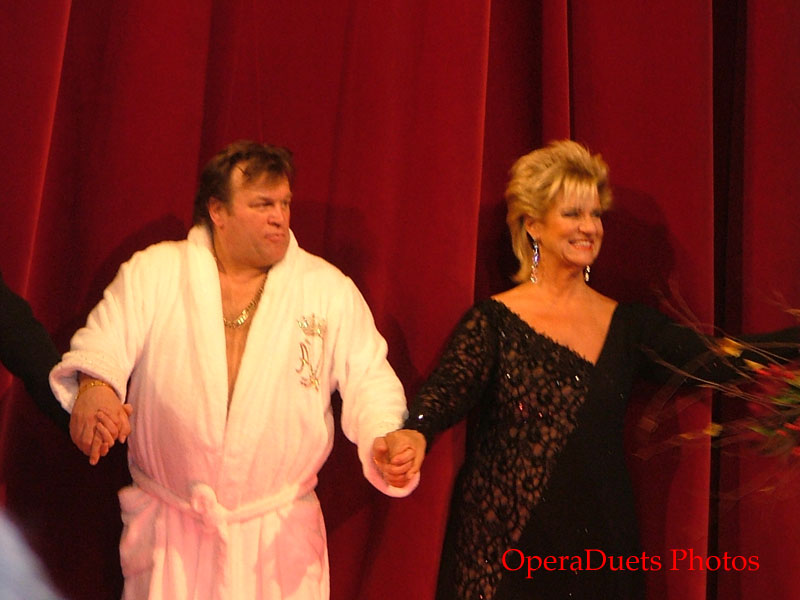
2007-11-24 Elektra (R.Strauss), Magyar Állami Operaház
Klytämnestra = Agnes Baltsa
Elektra = Nadine Secunde
Chrysothemis = Bátori Éva
Aegisthos = Gulyás Dénes
Orestes = Perencz Béla
Orestes nevelője - Cser Krisztián
Klytemneistra bizalmasa - Balogh Tímea
Uszályhordozónő - Polyák Valéria
Fiatal szolga - Megyesi Zoltán
Öreg szolga - Szegedi Csaba
A felügyelőnő - Kukely Júlia
1. szolgáló - Balatoni Éva
2. szolgáló - Érsek Dóra
3. szolgáló - Mester Viktória
4. szolgáló - Fodor Beatrix
5. szolgáló - Wierdl Eszter
Kovács János, conductor
Klytämnestra = Agnes Baltsa
Elektra = Nadine Secunde
Chrysothemis = Bátori Éva
Aegisthos = Gulyás Dénes
Orestes = Perencz Béla
Orestes nevelője - Cser Krisztián
Klytemneistra bizalmasa - Balogh Tímea
Uszályhordozónő - Polyák Valéria
Fiatal szolga - Megyesi Zoltán
Öreg szolga - Szegedi Csaba
A felügyelőnő - Kukely Júlia
1. szolgáló - Balatoni Éva
2. szolgáló - Érsek Dóra
3. szolgáló - Mester Viktória
4. szolgáló - Fodor Beatrix
5. szolgáló - Wierdl Eszter
Kovács János, conductor
Magyar nyelvű feliratok / Hungarian text Mesterházi Máté
Rendező / Director Kovalik Balázs
Díszlettervező / stage designer Antal Csaba
Jelmeztervező / costume designer Benedek Mari
Karigazgató / Chorus Master Szabó Sipos Máté
It is Premiere of Elektra and the opera house is wrapped in red on this occasion. Only two things bothered me: that my seat got very uncomfortable after 70 mins plus of Opera, real pain in my ..., and the end where Orest kills both his sisters with a machine gun, so totally unnecessary.
Nadine Secunde was great as Elektra (no surprise there), Eva Batori was wonderful as Chrysothemis. Agnes Baltsa was magnetic as Klytämnestra.
The production: Modern and set in a bath. It started startlingly with the opera house completely dark and then suddenly some light and the thunder of Straussian music. And unlike the Vienna production we could see the people and different types and real human being. The very self-assured über-type of woman, from the more submissive one. But to be onstage without shoes, naked but for some bathrobe or just a towel wrap round the bodies, I would guess they look forward to get dressed again. Some nakedness occurred, only male, and for a short time. Elektra had a black dress (dressed as widow), Chrysothemis in white (dressed as a bride). Klytämnestra also had black dress and a white fur robe. Orest dressed very formally but with sunglasses. Aigist had only a white bathrobe which made him very self-conscious when taking the bow at the end.
The changing of color lighting the stage was very well done. So naturally it got to be very red during some parts of the Elektra/Klytämnestra scene. The symbolism when Klytämnestra was killed was perfectly. No such symbolism for Aigist.
In the end after the murders:Chrysothemis was first greeted by Orestes people as Princess and goes out to dress herself as a new Klytämnestra. Elektra also changes out with the old puff, and a white robe is over the old black. But Elektra is not ready for the happiness, she struggles with the Agamemnon tree to Klytämnestra's bed, the power lies in the bed. She is clearly exhausted. But instead of having her die in the bed of mental exhaustment Orest has her killed with a machine gun. Two shots is heard, so when Orest is supposed to kill Chrysothemis with his second bullet, all Eva Batori can do is to drop dead with no sound.
The end ruined it, when Orest kills his sisters that does not make it a Real Greek Tragedy, but if his two sisters died just of exhausted minds when Orest should celebrate his triumph. THAT WOULD BE Greek Tragedy.
More about this Elektra
Tosca in Vienna 2007-11-23 with Jose Cura
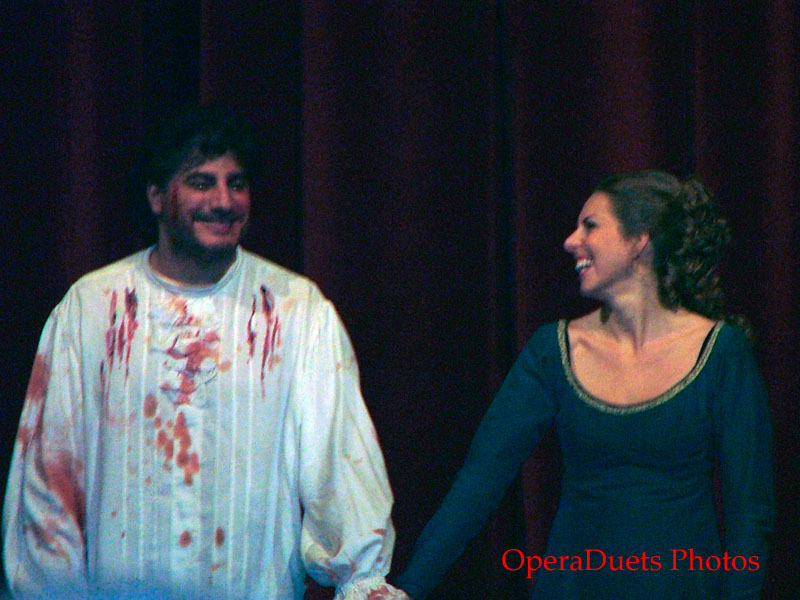
Tosca with José Cura as Mario Cavaradossi.
Tosca no 517:
Inszenierung Margarethe Wallmann
Bühnenbild und Kostüme: Nicola Benois
I missed a great Scarpia, Ruggero Raimondi is always great as Scarpia. Amarilli Nizza was Ok as Tosca. Liked her Vissi d'arte. José Cura and the conductor was not always in agreement. Cura wanted to be faster. He was also acting in a way inconsistent with the times, Neapolitan time. This was a very traditional Tosca with beautiful settings. It was a beautiful E lucevan le stelle. The end duet Tosca/Cavaradossi was great (good). But Nizza could not help herself when she leaped from the castle one might have thought this was one of the first Toscas in this production, very old fashioned (at least from the -50s). One arm raised....
2007-11-23 Tosca (G.Puccini), Wiener Staatsoper
Mario Cavaradossi = José Cura
Floria Tosca = Amarilli Nizza
Baron Scarpia = Marco Vratogna
Cesare Angelotti = Boaz Daniel
Der Mesner = Lars Woldt
Spoletta = Benedikt Kobel
Sciarrone = Clemens Unterreiner
Mario Cavaradossi = José Cura
Floria Tosca = Amarilli Nizza
Baron Scarpia = Marco Vratogna
Cesare Angelotti = Boaz Daniel
Der Mesner = Lars Woldt
Spoletta = Benedikt Kobel
Sciarrone = Clemens Unterreiner
Ein Schließer = Goran Simic
Paolo Carignani, conductor
Paolo Carignani, conductor
Subscribe to:
Posts (Atom)